Origins & History
From village deities and puppet stages to a refined dance-drama.
Yakshagana's establishment and evolution are rooted in the folk dance traditions of South India. Though no firmly dated inscription pins down its birth, the art's basic forms are believed to have taken shape in the coastal villages of the Kannada country well within earlier centuries, and the very word "Yakshagana" appears in Kannada literature even before the 16th century.
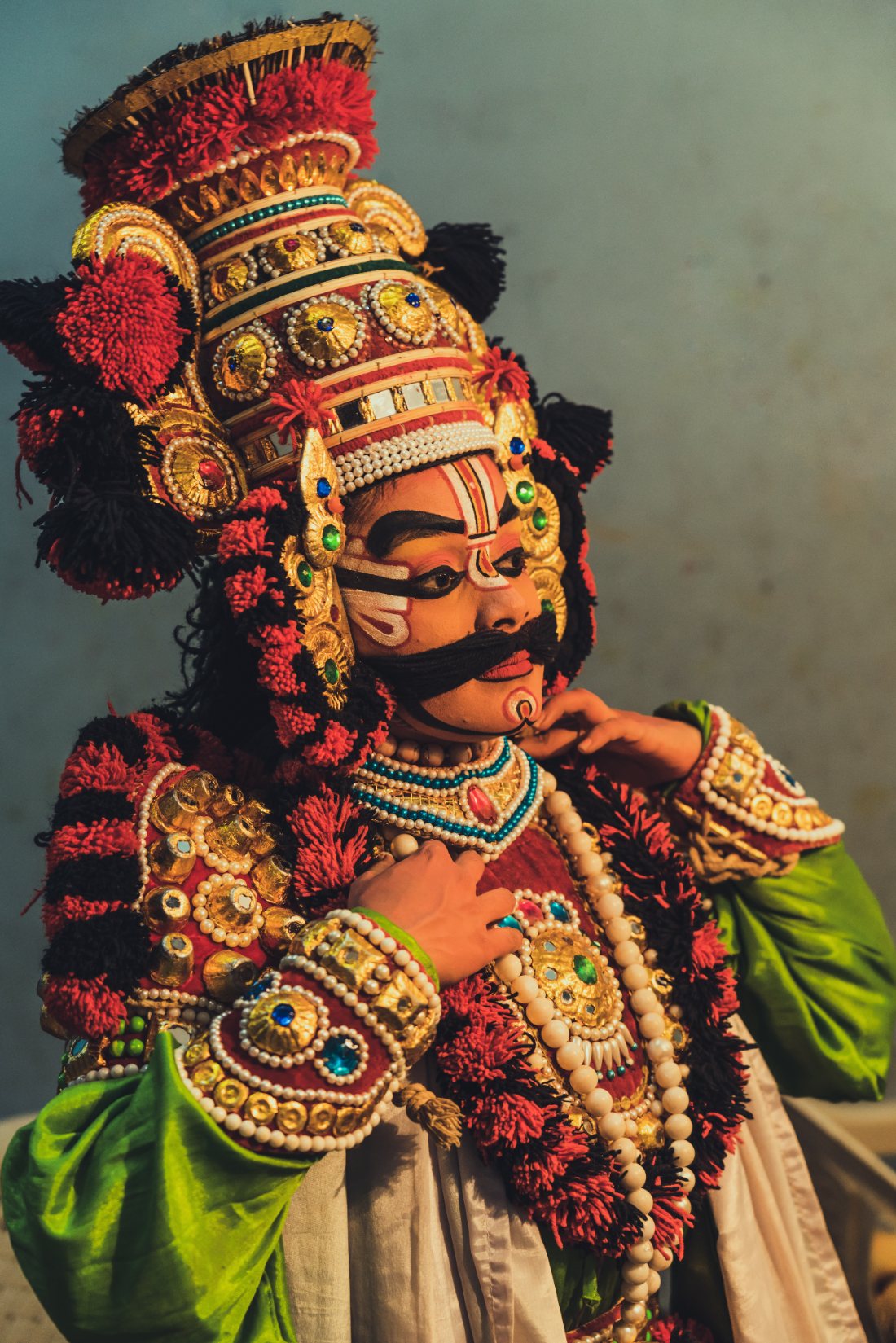 Before the performance
Scholarly origins
The scholars Govinda Rao and E. P. Rice suggest that the dance-drama form developed in the 15th–16th centuries from an older tradition of Hindu costume-and-story dance. Some trace its roots further still, to Kerala's yajna service narratives and Krishna devotional verses, as cited by Ulloor Purushottama Iyer.
According to tradition passed down over centuries, early Yakshagana was closely associated with puppet theatre (Nulpava Kuttu): artists performed in open pavilions, embodying giant, awe-inspiring forms. These styles grew out of the worship of village deities and Yakshas before giving rise to the more recognisable Yakshagana of today.
The art originated in the worship of village deities and Yakshas, only later becoming the grand stage tradition we know.
Centuries of refinement
Over time, troupes grew to enact daily narratives of divine or royal ideals as full stage productions. Research in the tradition of Dr. K. Shivaram Karanth suggests that regional rituals and ceremonies deeply shaped Yakshagana's character.
The form steadily expanded its reach: new literary compositions, more refined staging, adaptations of romantic and comic forms, and technological change, gas lamps giving way to electric lights, all combined to enrich its theatrical power and carry it into the modern age.
A timeline of the art
The word appears
"Yakshagana" is recorded in Kannada literature; the art grows from village deity and Yaksha worship.
The dance-drama takes shape
Per Govinda Rao and E. P. Rice, a costume-and-story dance form develops along the coast.
Touring tent melas
Professional troupes tour with new staging and licensed gas / electric lighting.
Karanth's Yaksharanga
Dr. Shivaram Karanth's experiments introduce refined elements and western stagecraft.
Idagunji Mahaganapathi Mela
One of the great Badagutittu melas is formally established.
Shrimayya Kala Kendra
Keremane Shambhu Hegde founds a residential gurukula at Gunavante, Honnavar.
Yakshamanjushe in Hindi
Vidya Kalyure begins staging Yakshagana in Hindi, taking it across North India.
UNESCO recognition
The Keremane Idagunji Mandali is listed on UNESCO's Representative List of Intangible Cultural Heritage.